Planck Dynamics Is Now In Orbit
When the link is gone, the system still has to decide. On 7 July, our Blackbird Alpha payload reached orbit. Here is what it is testing, and why a satellite is the hardest possible proof of a problem we work on every day.
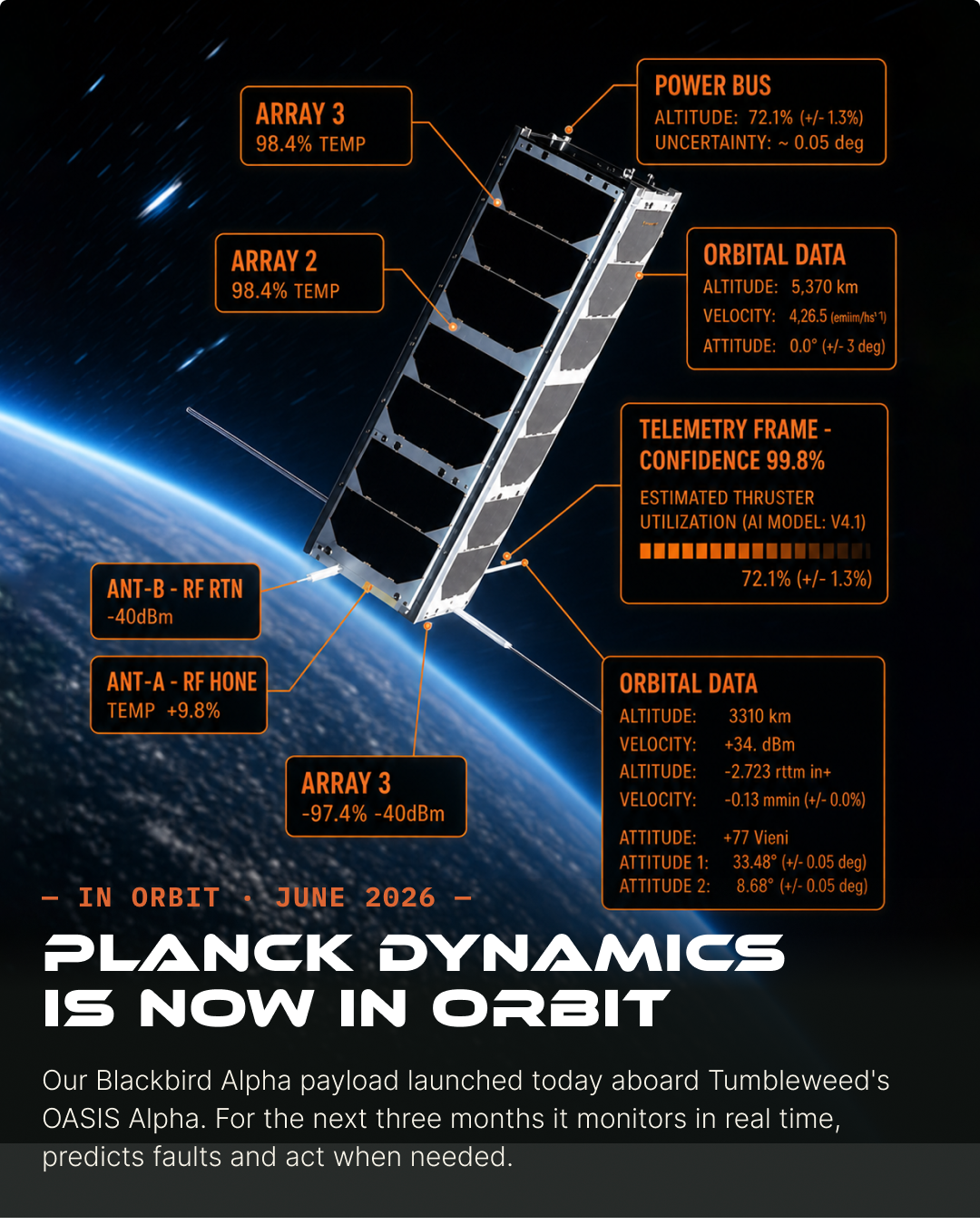
This morning, a SpaceX Falcon carried our Blackbird Alpha payload to orbit. It flies as a self-contained hardware and software payload aboard Tumbleweed's OASIS Alpha satellite, on a mission planned to run for roughly three months. The payload was designed by our Managing Director, Nathan Eskue, professor of AI at TU Delft Aerospace Engineering, and built by our team.
Blackbird Alpha is a demonstrator. Its job is not to run a spacecraft. Its job is to answer one question under real orbital conditions: can an AI system be trusted to look after a spacecraft in the moments when no human can?
The problem we are actually testing
A satellite spends much of its life out of contact with the ground. Passes over a station are short, links are intermittent, and the craft is on its own between them. When a fault begins to develop in that window, the usual model, wait for telemetry to reach an operator and wait for a command to come back, is too slow. The damage is done before the loop closes.
This is the same problem we work on at the tactical edge, stated in its hardest form. A vehicle can lose its link. A dismounted unit can be denied communications entirely. The requirement does not change: the system has to keep making good decisions when the connection is gone. A satellite is that requirement with no shortcuts, because there is no operator standing next to it and no second chance if it gets the call wrong. It also operates in some of the harshest conditions possible between extreme temperature swings, unpredictable radiation, and the intense shock/vibe from the launch to orbit.
How the payload works
Blackbird Alpha runs a suite of AI models built for spacecraft health optimization. In orbit, the models do four things in sequence, continuously:
- Read. They ingest data from across the spacecraft's systems in real time.
- Estimate. They assess the current state of health of those systems, not as a fixed threshold check, but as a live picture.
- Predict. They identify issues that are on a path to damage the craft, before those issues become failures.
- Act, or escalate. When they find a developing problem, they do one of these two things.
That final step is where the work concentrates. The models either send a diagnosis to the ground team so a human can resolve it on the next pass, or, when the situation is time-critical and their confidence is high enough in both the risk and the fix, they simulate the correction and apply it autonomously. The decision to escalate or to act is not a fixed rule. It is a function of how certain the models are and how much time there is.
The confidence threshold is the whole point
Most AI fails in the field for a reason that has nothing to do with raw capability: it acts with the same confidence whether it knows the answer or is guessing. That is tolerable in a recommendation engine. It is not tolerable on a spacecraft, or in a vehicle, or anywhere a wrong action carries real cost.
Our models attach uncertainty to every output. This is our Uncertainty-Aware approach, and it governs behavior. The craft acts on its own only when the evidence supports the risk, the fix, and the timing simultaneously. When any one of those is not certain enough, the system does the disciplined thing and hands the decision back to a human, providing its assessment along with the Uncertainty-Aware measurements so the human can quickly understand how much they should trust the AI model’s recommendations. An autonomous system that acts should also know when it should not. That distinction is what we flew Blackbird Alpha to prove.
What this is, and what it is not
We are precise about this because these types of extreme edge, high risk missions depend on it. Blackbird Alpha is an early version. A pathfinder. These are first-generation models running in a demonstrator payload, and the point of the mission is to learn where they hold and where they need work before the next iteration. We are not claiming a finished capability, but rather an excellent learning opportunity to build up that robust set of models that are mature and have proven themselves in the most challenging conditions possible.
The reason to fly it now is that orbital conditions cannot be simulated away. Representative-environment evidence is the only kind that counts, and three months of it will tell us more than another year of ground testing.
Where this points
The same discipline that keeps a satellite safe out of contact is the discipline the tactical edge demands: real-time analysis on the platform, prediction before failure, and action that is scoped by how certain the system actually is. Whether the edge is a spacecraft above a ground station or a vehicle beyond its link, the requirement is the same, and so is the answer.
Our thanks to Nassim Amellal and Patrick Lau, who did the heavy lifting to get Blackbird Alpha built and flight-ready, to the team at TU Delft Aerospace, and to Tumbleweed, whose launch model makes flights like this possible for teams like ours.
We will share what we learn over the next three months. Both the wins and the surprises.